
The salty spray of the sea, felt from the bow of a wooden ship. An oasis of cool water in the vast expanse of desert. Snow covered mountains and shards of ice on slick stone.
Water is an amazing thing, as I’m sure you are well aware. It shows up all around us, pumping life into the trees, dripping from the sky onto our waiting umbrellas, forming in the air around us as silvery mist, condensing on the grass to make the world sparkle in the morning, taking the form of summer (and winter) snow cones, and so much more.
And yet, even when we’re actively trying not to, it’s so very easy to take it for granted—to look at the abundance of water and feel nothing.
Take rain, for instance—water that literally drops from the sky, splashing across leaves, shingles, and cement equally. And yet, culturally, rain is considered gloomy—the clouds that bear it darken the sky, and the water forbids outdoor excursion for fear of getting cold and soggy.
But of course, this seems natural enough, doesn’t it? It certainly makes being outside more uncomfortable, even dangerous due to the odd substance that forms when water meets dirt, not to mention the chance of hydroplaning if the rain tries hard enough.
But can you imagine the first time it rained? Can you picture the look on peoples’ faces when water began pouring on them from the clouds? We think a great deal more about the manna that God rained on Israel than we do about the water He rains on us, but really, they’re quite similar. Both are life-sustaining gifts from God, and both have been taken for granted. Of course, imagining manna raining down on us, it’s easy to think we would never take it for granted. But wouldn’t we? Once you’ve had something for forty years, especially if you grew up with it, as the Israelite children did, it gets a little easier to take it for granted.
Yet sometimes it’s the most commonplace things that are truly the most special. Jesus said that He was the bread of heaven and the living water. Food and water—two things that we have every day, that we need to survive, and yet that we take for granted. He didn’t say He was the popcorn and Pepsi, or even the figs and wine. While I’m not saying any of these are inherently bad things, they aren’t what Jesus said. He said He was the bread and water. Ordinary, but miraculous, gifts.
Growing up, I didn’t think much of rain. I wanted sunny weather and clear skies, maybe dotted with a few crisp, white clouds and traversed by a colorful bird or two. Either that, or I wanted buckets of snow covering the ground and dancing in the air. But rain was the every-day, monotonous bore that I never really cared about. Until I moved. Now that sunny days abound and rain comes far less frequently, I’ve found myself longing for the sound of its tap dancing on my roof and the pleasant, earthy feeling lingering in the air long after the last droplet slips from the sky.
Rain is a beautiful gift, and it’s one I wish I had had more of an appreciation for growing up.
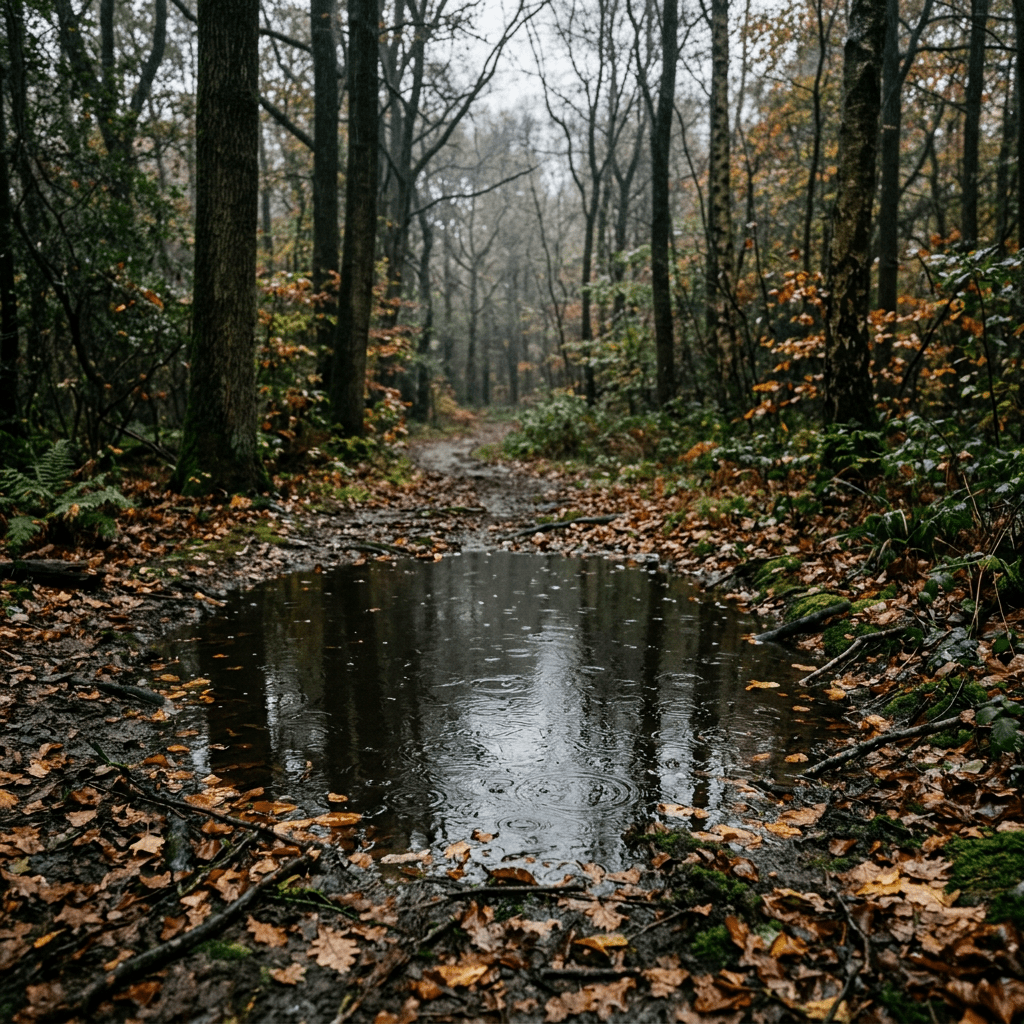
So next time a droplet lands on your nose or you wake up to find the sun blocked out by drizzling clouds, take a moment to appreciate the beauty of the rain. And—dare I say it?—next time you accidentally step into a puddle disembarking from your car in your beautiful, new, but definitely not waterproof shoes, take a moment then as well, not to wish away the life-nourishing liquid seeping into your socks, but to marvel at the abundance with which God blesses us. Many would pray for a pool of water such as that.
With the puddle water turning your feet into raisins, I would also recommend taking a second to picture the scene as if you were inside of a book.
Of course, in a book I should hope the puddle had some effect on the protagonist other than simple discomfort. Perhaps it made them irritable towards their family, souring an important morning in their life. Or maybe they were so focused on their feet, that they didn’t notice when something of theirs was stolen. Or maybe they were transported to a desert, and their wet shoe ended up saving them. There are endless possibilities, but whatever the case, if it’s a well written book, there ought to be some kind of consequences for stepping into the puddle.
Your life is no different, believe it or not. Just as how in a good book every decision contributes something meaningful, each decision you make (and every so-called coincidence) is used by God to affect you in some way, whether it’s to better your character, push you into a situation you otherwise would have avoided, or spread a sliver of light to someone else.
The wet shoe, for instance, isn’t just a wet shoe. It’s an opportunity to model joy and contentment in uncomfortable circumstances.
Because Christian joy isn’t a result of good circumstances—it’s the choice that defines your perception of your circumstances.
Paul says in Philippians 4:11-13 that he learned to be content in all things through Christ. Being content and finding joy isn’t about where you are—it’s about how you view it. It’s about Who you rely on. Even in the darkest of times, you can learn to view your life through God’s eyes. You can learn to rely on Him, and by doing so, you can learn to take joy. We are called to be lights, not just when we’re prospering in the world’s eyes, but when we’re hated. When we’re slandered. When we’re imprisoned, killed, abused. And how can we do that if we act just as the unbelievers do when we face adversity? Why would anyone see us as different if we complain and wallow in self-pity when we find ourselves in difficult places?
Philippians 2:14-15 tells us to “Do all things without complaining and disputing, that you may become blameless and harmless, children of God without fault in the midst of a crooked and perverse generation, among whom you shine as lights in the world”. One way the world sees Christ in us is by our joy. By our contentment, even in the worst of situations. Like Paul and Silas singing while imprisoned.
Of course, that kind of joy can be difficult to cultivate, but it is possible. Even commanded.
They say that half the battle is lost as soon as you believe you can’t win, and that’s certainly the case with joy. As soon as you think that you can’t be joyful when your circumstances are grim, it becomes nigh impossible to discover otherwise.
You need to believe—to trust—that God is working all things for your good and His glory. Trust in Him, and be willing to learn how to find joy in all things.
So, when the rain comes down and soaks your feet, imagine yourself as a character in a book, and try to figure out what a book character would be learning. Trust in God, the great Author, and seek that joy which He has promised to those who cling to Him.


Leave a Reply